- Mengambil wuduk
- Memilih tempat belajar kondusif
- Beristighfar daripada dosa sebelum mula
- Baca doa.
- Baca dulu topik-topik utama
- Cuba ingati dengan mengulang fakta
- Tulis semula bagi mudah ingat
- Ulangkaji dalam masa 24 jam
- Cari peluang untuk mentelaah jika ada masa terluang
- Hari cuti digunakan mengulang kaji ilmu dikuasai
- Meringkaskan fakta-fakta kepada mudah difahami dan senang ingat.
- Cuba menjawab soalan-soalan berkaitan ilmu dikuasai
- Lakukan bersama dalam kumpulan study group
- Bincangkan idea-idea utama dan topik dikuasai bersama rakan
- Bertanya kepada pakar dalam perkara yang samar-samar atau sukar difahami
Sunday, September 7, 2014
TIPS CEMERLANG DALAM PELAJARAN
Perkara yang baik sebelum, semasa dan selepas sesi mrngulang kaji pelajaran:-

CIRI-CIRI MANUSIA YANG BERSIKAP POSITIF
- Ikhlas
- Takwa
- Bermatlamat
- Mengamal ilmu yang dikuasai
- Taat kepada ibu bapa dalam perkara-perkara baik
- Tinggalkan perkara tidak bermanfaat
- Hindari rakan taulan berperangai buruk
- Meminta perlindungan ALLAH SWT
- Menjaga solat
- Menjauhi perkara haram
- Berakhlak terpuji
- Kemas
- Konsisten berusaha tanpa putus asa
- Tolong kawan-kawan
- Berkelakuan jujur dan benar
- Berprinsip utuh
- Menjaga maruah diri, keluarga, masyarakat dan negara
- Amal sifat mulia
- Berhemah tinggi
- Menghargai kenalan baik
- Sentiasa mengigati ALLAH dan membaca Al-Quran
- Mengajak melakukan kebaikan dan menjauhi segala pebuatan jahat
- Menjaga kesihatan diri
- Berhemah dalam gembira/ketawa
- Waktu terluang di isi dengan amalan baik
- Menjaga waktu untuk keperluan kerja dan ibadah serta mendahulukan kerja yang utama
- Tidak menipu
LANGKAH-LANGKAH UNTUK BERUBAH
- Minat untuk belajar.
- Konsisten mengejar kejayaan.
- Tidak melakukan jalan pintas dalam menuntut atau pelajari apa jua kerja.
- Bertanggungjawab melaksanakan sesuatu kerja sehingga selesai dan sempurna.
- Melakukan perubahan secara berperingkat-peringkat.
- Mengamalkan sikap positif sepanjang masa dan mempraktikan ciri-ciri orang berjaya serta cemerlang.
WHAT IS SOCIAL SCIENCE?
To anyone who actually just got-in or jump-into the group that migrating from pure science research to social science research. You might fill a bit difficult to understands the difference between both sciences. The one thing that I actually learn was the statistics for analytical data process does not have much difference only that in pure science usually the data in the numeric form but contrary to social science where the data scales was sometimes in ordinal, nominal, interval, and ratio.
Actually, the social sciences are the fields of study of people in the society. It is commonly used to refer to a plurality of fields outside of the natural or pure sciences. There are various subfields namely includes anthropology, archaeology, business administration, criminology, economics, education, geography, linguistics, political science, government, sociology, international relations, communication, and, in some contexts, history, law, and psychology. According to UPM ezproxy (2013) library characterization such as below:-
Social Sciences
- Balance of trade
- Boards of trade. Chambers of commerce.
- Business
- By region or country
- Commercial geography. Economic geography
- Commodities. Commercial products
- Classes
- Human settlements. Communities
- Races
- Rural groups. Rural sociology
- Urban groups. The city. Urban sociology
- Business cycles. Economic fluctuations
- Capital. Capitalism
- Competition. Production. Wealth
- Consumption. Demand
- Demography. Population. Vital events
- Economics as a science. Relation to other subjects
- History of economics. History of economic theory
- Income. Factor shares
- Methodology
- Price
- Banking
- Credit. Debt. Loans
- Finance management. Business finance.
- Foreign exchange. International finance. International monetary system
- Insurance
- Investment, capital formation, speculation
- Money
- Personal finance
- Trust services. Trust companies
- Agriculture
- Economic growth, development, planning
- Industry
- Labor. Work. Working class
- Land use
- Large industry. Factory system. Big business
- Management. Industrial management
- Special industries and trades
- By region or country
- Expenditures. Government spending
- Income and expenditure. Budget
- Local finance. Municipal finance
- Periodicals. Serials. By region or country
- Public accounting. Auditing
- Revenue. Taxation. Internal revenue
- Accidents. Prevention of accidents
- Alcoholism. Intemperance. Temperance reform
- By region or country
- Criminal justice administration
- Criminology
- Drug habits. Drug abuse
- Emergency management
- Free professional services
- Protection, assistance and relief
- Refugee problems
- Social service. Social work. Charity
- Tobacco habit
- Communism
- Anarchism
- /socialism in relation to special
- Communism: Utopian socialism, collective
- Utopias. The ideal state
- Culture
- Deviant behavior. Social deviance
- Groups and organizations
- Social change
- Social institutions
- Social psychology
- Social structure
- Theory. Method. Relations to other subjects
- Registration of vital events. Vital records
- Statistical data
- Statistical services. Statistical bureaus
- Theory and method of social science statistics
- Life skills. Coping skills. Everyday living
- Life style
- Men
- Sex role
- Sexual life
- The family. Marriage. Home
- Women. Feminism
- Air transportation. Airlines
- Artificial satellite telecommunications
- Automotive transportation
- Cellular telephone services industry. Wireless telephone industry
- Express service
- Ferries
- Freight (General)
- Messenger service
- Passenger traffic (General)
- Postal service. Stamps. Philately
- Railroads. Rapid transit systems
- Signaling
- Stage lines
- Telecommunication industry. Telegraph
- Telephone industry
- Traffic engineering. Roads and highways.
- Transportation geography. Trade routes
- Urban transportation
- Water transportation
 |
| Social Science Network Map |
In a very typical amature researcher who changed to the social science field must at least know about the earlier phillosopher of the 19th century includes Émile Durkheim, Karl Marx and Max Weber. They are most typically cited
as the principal architects of modern social science. In modern
academic practice, researchers are often eclectic, using multiple
methodologies (for instance, by combining the quantitative and
qualitative techniques). The term "social research" has also acquired a
degree of autonomy as practitioners from various disciplines share in
its aims and methods (Wikipedia, 2013).
References
SJR (2014). SCImago Journal Rank. The Scimago Lab Networks. Retrieved from http://www.scimagojr.com/countryrank.php
UPM Library (2013). Ezproxy search engine. Serdang: Universiti Putra Malaysia.
Wikipedia (2013). Social Sciences. Wikipedia, the free encyclopedia. Retrieved from http://en.wikipedia.org/wiki/Social_sciences
Saturday, September 6, 2014
EDU-PARK @ UNIVERSITI PUTRA MALAYSIA
Edu-Park is an experiental learning package suitable for both adults and children. Visitors have a chance to explore the academic world of a Malaysian Research University and extract knowledge and skills from experts in their fields. It is part of programme for Visit Malaysia 2014 in collaboration with the Tourism Malaysia and the Ministry of Tourism and Culture Malaysia.
Overview of Universiti Putra Malaysia

Objectives
The main obejctives of the programmes are to:-
Facilities and Enjoyment Awaits You
Step into the realm of a Research University that has started as School
of Agriculture in 1931. Bordering the metropolitan cities of Putrajaya
and Kuala Lumpur, UPM will bids you welcome to explore harmonious campus life
that is occupied by more than 27,000 students from various countries
and cultural backgrounds. With its gargantuan size, measuring 1000
hectares, visitors are free to appreciate the breath-taking views of the vast
plantations and jaw-dropping green landscapes.
This opportunity
is a moment for visitors to understand the process of doing research through
interaction with the use of various research facilities, accompanied by
the best quality in teaching. Together, we increase the knowledge and
skills through a conducive learning atmosphere along with guidance
provided by UPM experienced and trained experts. Not only that, while
relishing the palpable wonders around, visitors may also take time to
pick your favorite fresh products right from the farm at affordable
prices. It's time to PLAY, LEARN and stay
YOUNG! Come and join the edu-tourism programme, specially crafted by
Edu-Park for you!
The UPM green environment welcomes you with ship-like guard entrance in the main campus and drove you away into the UPM greenary heaven.
Mission
Bridging the university and society through experiental learning.
Mission
Bridging the university and society through experiental learning.
Objectives
The main obejctives of the programmes are to:-
- Promote UPM as a tourist destination.
- Translate UPM's research outputs into products and experiences beneficial to the general public.
- Give understanding and opportunity for the community, society, and tourists both within and outside the country to recieve knowledge in UPM through experiental learning.
- Encourage the love for the environment and maintenance of health.
- Give real life experience to students through industrial training and incubation.
- Facilitate UPM staff and student in conducting research in the area of edu-tourism.
- PUTRA MART
- L'APPRENTI CAFE AND RESTAURANT
- TRANSPORTATION TRAMP SERVICE
- SERDANG GALLERY
The Serdang Gallery offers you a pleasure to discover trail of lust UPM landscape scenery and four packages that will ador you. The Serdang Gallery is situated at the PUTRA SCIENCE PARK Administration Building. You can explore the walk-about in the gallery indoor 1, gallery indoor 2 and for an outdoor tour; there are four package of guided tour includes Place Trails, Forest Trails, Ceremonial Trails, and Unique Trails. In the gallery indoor 1 is a walk through the world of information regarding to UPM history timeline from the establishment of School of Agriculture in 1931 until now. Further in depth, the gallery indoor 2 showing the live-long achievement of UPM research and development from the product commercialization overview. - UPM CONSERVATORY PARK
- FARM 16
- PUTRA DAIRY FARM
- UPM EQUINE CENTER
- UPM HUMAN ANATOMY MUSEUM
- UPM ANIMAL ANATOMY MUSEUM
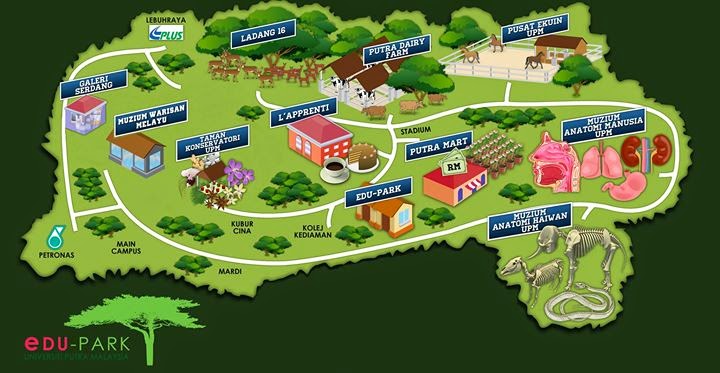 |
| UPM Edu-Park Map |
Contacts
- Facebook Page:https://www.facebook.com/pages/Edu-Park/1374861442753011
- Edu Park UPM Promotional Video 2014: http://www.youtube.com/watch?v=i3pA5JGFNME
- Visit UPM Edu-Park Homepage: http://www.edupark.upm.edu.my/
- Email Address: edupark.upm@gmail.com
- Any Enquires: EDU-PARK, PUTRA SCIENCE PARK, Call @ Office Phone: 03-89471413 or 1419.
LANGKAH-LANGKAH UNTUK BERJAYA
- Mengubah sikap buruk kepada sikap terpuji.
- Membuat perubahan diri sedikit demi sedikit, peringkat demi peringkat.
- Mempositifkan diri dalam setiap perkara dan cabaran yang ditempuhi.
- Melakukan perkara wajib dengan segera tanpa berlengah.
- Mengambil peluang dengan sebaik-baiknya.
- Melakukan segalanya dengan cermat, sepenuh hati dan tidak sambil lewa atau ala-kadar.
KELEBIHAN MENUNTUT ILMU
Ilmu
Ilmu adalah pengetahuan yand memberikan manfaat kepada diri dan orang disekelilingnya. Ilmu yang baik memberi cahaya kepada orang yang pandai memanfaatkannya dan memberi cahaya kepada semua yang menyebarkannya.
Menuntut Ilmu
Manakala menuntut ilmu adalah suatu ibadah yang wajib kerana ALLAH SWT dan merupakan ciri-ciri pelajar soleh. Seorang pelajar yang baik mempunyai matlamat hidup yang jelas dan hala tuju yang betul atau mind set yang tepat. Seseorang yang tidak mengetahui keperluan ilmu sehinggalah dia mengetahui hakikat dan kelebihan ilmu itu sendiri.
Kelebihan Menuntut Ilmu
Justeru itu, kelebihan menuntut ilmu adalah seperti berikut:-
Jihad dalam menuntut ilmu pula adalah merupakan segala usaha di fokuskan atau komited untuk menegakkan kalimah ALLAH SWT. Ilmu lebih penting daripada harta. Ilmu yang baik diamalkan akan beroleh harta kekayaan dengan adanya usaha berterusan tanpa putus asa. Ilmu akan semakin bertambah dengan menyebarkannya dan tidak kurang sedikit pun jika ia di sebarkan. Orang yang mengajar dan menyebarkan ilmu yang bermanfaat akan beroleh kejayaan, manakala mereka yang menerima ilmu pengatahuan yang diajarkan akan menyebarkan pula kepada orang lain dan ianya akan berterusan. Kata lainnya, mengajar orang ilmu akan beroleh pahala, menerima ilmu orang yang bermanfaat dan mengamalkannya akan beroleh pahala juga, dan seterusnya. Ia adalah suaru yang berulang. Marilah kita menjadi orang yang berjaya
Mencintai Ilmu
Ilmu perlu dipelajari dan dicintai serta dituntut dalam agama. Dari sejak lahir hinggalah ke liang lahad, seseorang manusia itu dituntut untuk mencari ilmu dan mengamalkan ilmu yang memberi manfaat kepadanya. Jadi kenapa tidak ilmu itu dicintai kerana ia sangat dekat dengan segala aktiviti yang kita lakukan pada setiap hari. Ilmu hanya akan terputus selepas kita meninggal dunia. Manakala ilmu yang diamalkan oleh pelajar kita akan memberi cahaya kepada kita di akhirat kelak.
Surah Berkaitan Ilmu
Surah-surah yang berkaitan menyebut tentang darjat pengamal ilmu dan berkaitan pengetahuan ilmu:-
Ilmu adalah pengetahuan yand memberikan manfaat kepada diri dan orang disekelilingnya. Ilmu yang baik memberi cahaya kepada orang yang pandai memanfaatkannya dan memberi cahaya kepada semua yang menyebarkannya.
Menuntut Ilmu
Manakala menuntut ilmu adalah suatu ibadah yang wajib kerana ALLAH SWT dan merupakan ciri-ciri pelajar soleh. Seorang pelajar yang baik mempunyai matlamat hidup yang jelas dan hala tuju yang betul atau mind set yang tepat. Seseorang yang tidak mengetahui keperluan ilmu sehinggalah dia mengetahui hakikat dan kelebihan ilmu itu sendiri.
Kelebihan Menuntut Ilmu
Justeru itu, kelebihan menuntut ilmu adalah seperti berikut:-
- Mendapat keredhaan ALLAH SWT.
- Diri dirahmati ALLAH SWT.
- Beroleh rezeki yang halal.
- Kedudukan orang yang berilmu adalah begitu tinggi di sisi ALLAH SWT.
- Dapat beribadat dengan khusyuk dan jelas.
- Dapat memanfaatkan diri, masyarakat dan umat.
- Diri semakin hampir dengan ALLH SWT.
- Mendapat kefahaman dalam urusan agamanya dan juga duniawinya.
Jihad dalam menuntut ilmu pula adalah merupakan segala usaha di fokuskan atau komited untuk menegakkan kalimah ALLAH SWT. Ilmu lebih penting daripada harta. Ilmu yang baik diamalkan akan beroleh harta kekayaan dengan adanya usaha berterusan tanpa putus asa. Ilmu akan semakin bertambah dengan menyebarkannya dan tidak kurang sedikit pun jika ia di sebarkan. Orang yang mengajar dan menyebarkan ilmu yang bermanfaat akan beroleh kejayaan, manakala mereka yang menerima ilmu pengatahuan yang diajarkan akan menyebarkan pula kepada orang lain dan ianya akan berterusan. Kata lainnya, mengajar orang ilmu akan beroleh pahala, menerima ilmu orang yang bermanfaat dan mengamalkannya akan beroleh pahala juga, dan seterusnya. Ia adalah suaru yang berulang. Marilah kita menjadi orang yang berjaya
Mencintai Ilmu
Ilmu perlu dipelajari dan dicintai serta dituntut dalam agama. Dari sejak lahir hinggalah ke liang lahad, seseorang manusia itu dituntut untuk mencari ilmu dan mengamalkan ilmu yang memberi manfaat kepadanya. Jadi kenapa tidak ilmu itu dicintai kerana ia sangat dekat dengan segala aktiviti yang kita lakukan pada setiap hari. Ilmu hanya akan terputus selepas kita meninggal dunia. Manakala ilmu yang diamalkan oleh pelajar kita akan memberi cahaya kepada kita di akhirat kelak.
Surah Berkaitan Ilmu
Surah-surah yang berkaitan menyebut tentang darjat pengamal ilmu dan berkaitan pengetahuan ilmu:-
- Surah Al-Baqarah : Ayat 269.
- Surah Ali Imran: Ayat 18.
- Surah Al-Mujahadah: Ayat 11.
- Surah Al-Zumar: Ayat 9.
- Surah Al-Ra'd: Ayat 28.
Subscribe to:
Posts (Atom)